An endless runner on real music paper: ride the 3rds and 7ths through chord changes while the band plays behind you. Guide tones, voice leading, and chart-reading — trained at tempo, not explained on a whiteboard.
Improvisation gets taught as scale-picking, so young players run notes that are technically "allowed" and musically lost. The fix has been known for a century — guide tones, the 3rds and 7ths that carry the harmony — but there's never been a way to drill them that a student would choose to do.
Soloing feels like a test with invisible rules. The blues scale becomes a hiding place.
Backing tracks and play-alongs perform at the student. Nothing listens back, nothing corrects, nothing reports.
One rehearsal, thirty kids, no way to know who actually ran the changes at home.
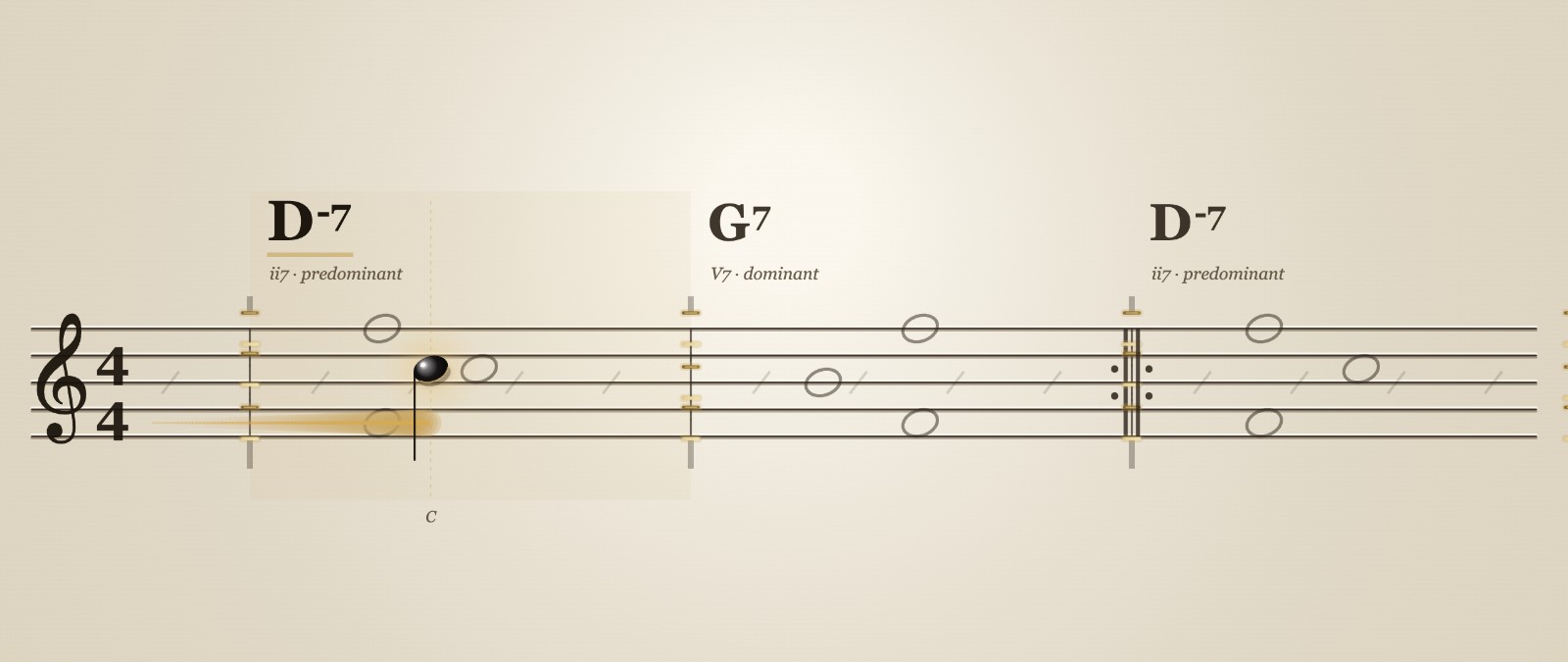
A quarter note on a real staff — key signatures, accidentals, rests, courtesy naturals. Wherever you stand, you sound. Move freely: melody is never punished.
Every barline is a gate. The two golden doors are the guide tones — the 3rd and the 7th of the coming chord. Be inside one when the bar lands. Root & 5th are safe. Everything else is a void note, and you'll hear it.
Walking bass, brushes, shell voicings — a rhythm section in your browser. Thirty levels from a first ii–V–I to Autumn Leaves, rhythm changes, and Giant Steps at 200.
Not mockups — frames straight from the engine. A glossy black note, a golden trail of everywhere you've been, and the guide-tone doors in metallic gold on engraved paper.
Built with band directors and studio teachers in mind — no accounts, no IT approval, no cost. Text a link; get an étude back.
Pick the level, key, and tempo — send one link. It opens ready to play on any student phone.
After a run: doors hit, voice-leading grade, longest line. Students send it back as their practice receipt.
One-chord isolation, A/B looping on trouble bars, and a tempo ladder — the practice-room rituals, built in.
Pause and tap any door: "E♯ — the 3rd of C♯7, V7/ii." Theory answers at home, not just in lessons.
Most music apps think in piano keys, so they can't tell E♯ from F — and print guide tones on the wrong line. Run the Changes is built on THIRI, a deterministic music-theory engine: every chord spelling in the game is validated against it, and the validation table ships inside the game for anyone to check. Developers can build on the same engine at build.thiri.ai.